."Myth Trek".
Intertwining culture with education through gamified storytelling.
Html 5 MacOS Windows RC Athena, Multimedia Research Group
C. Kiourt, G. Pavlidis and S. Markantonatou (2017), Intertwining culture with education through gamified storytelling - the case of “Myth Trek”, International Journal of Computational Methods in Heritage Science (IJCMHS), (Under review).“Myth Trek”
Coupling culture and education has attracted significant attention and pushed towards the replacement of the typical STEM model into STEAM. An effective integration of culture in the everyday educational practice, empowered by game-based storytelling has already shown great potential in transforming the way people are exposed to and grasp knowledge. This work presents an attempt to put culture, education, gaming and storytelling together. Myth Trek, a game developed with state-of-the-art gaming technology, has integrated elements going back in time all the way to the ancient Greek mythology, embedding a time-distorted history onto the present day’s landscape in the center of the city of Athens, the goal being saving Athens from complete annihilation. In a playful action/adventure gaming setting, the game merges mythology, history, architecture and the environment to emerge players in the long history of Athens.
User Guide
Gameplay Instructions:
- WASD or Arrows: Navigation and mouselook.
- Space: Jump.
- Esc: Pause mouselook.
- Ctrl+M: Show/Hide the big map for location and orientation information.
- Ctrl+C: Crouching.
- Rigt mouse click: Power-up special items selection.
- Alt + left mouse click: Use of the selected power-up special items
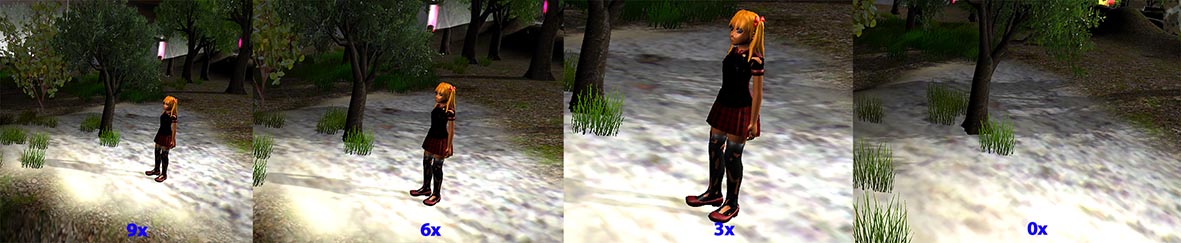
- Mouse Wheel Scroll: Changing from first-person to third-person gameplay, changing the zoom factor in third-person gameplay.
Navigation within the game is based on mouse and keyboard combinations for camera movement and avatar control and interaction. This includes jumping, crouching, collecting or using the special items, changing from first-person to third-person gameplay, changing the zoom factor in third-person gameplay (next Figure), and saving and restoring games. When a game starts, the user logs in and is able to select to load the last saved game or restart the quest from the beginning. The user is informed about the score, health status and power-ups in the last saved game before making a choice. During the game the player completes tasks, faces opponents (enemies) and gains keystone items (stars in the prototype app), score and power-ups.
Gamification
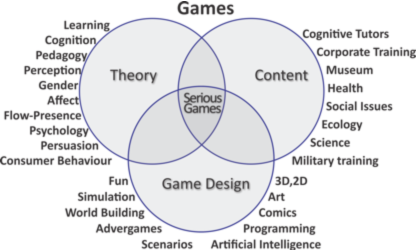
Gaming for educational purposes is a significant and active research domain. This has taken either the form of game-based learning or serious gaming. As shown in next Figure, gamification in this sense is the result of serious games based on learning, the content and game design.
The importance of playing has been emphasized in many studies from various domains. According to Brown and C. Vaughan (2010), playing is an archetypical activity that arises from primordial biological structures existing before the conscience or the capacity for speech; it is not something a person decides to do. According to S. Nicholson,(2011-2012), gamification is nothing more than the use of specific game design approaches and techniques in various environments, in order to attract people in problem solving and to enhance their contribution.
Mythology and game scenario
The Philopappou Hill to the WSW of the Acropolis of Athens
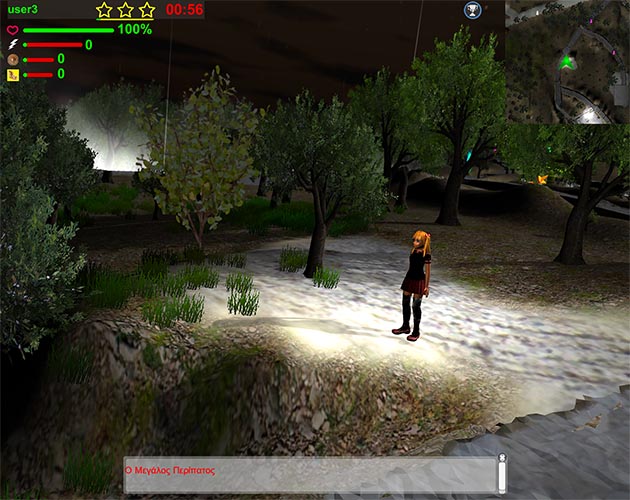
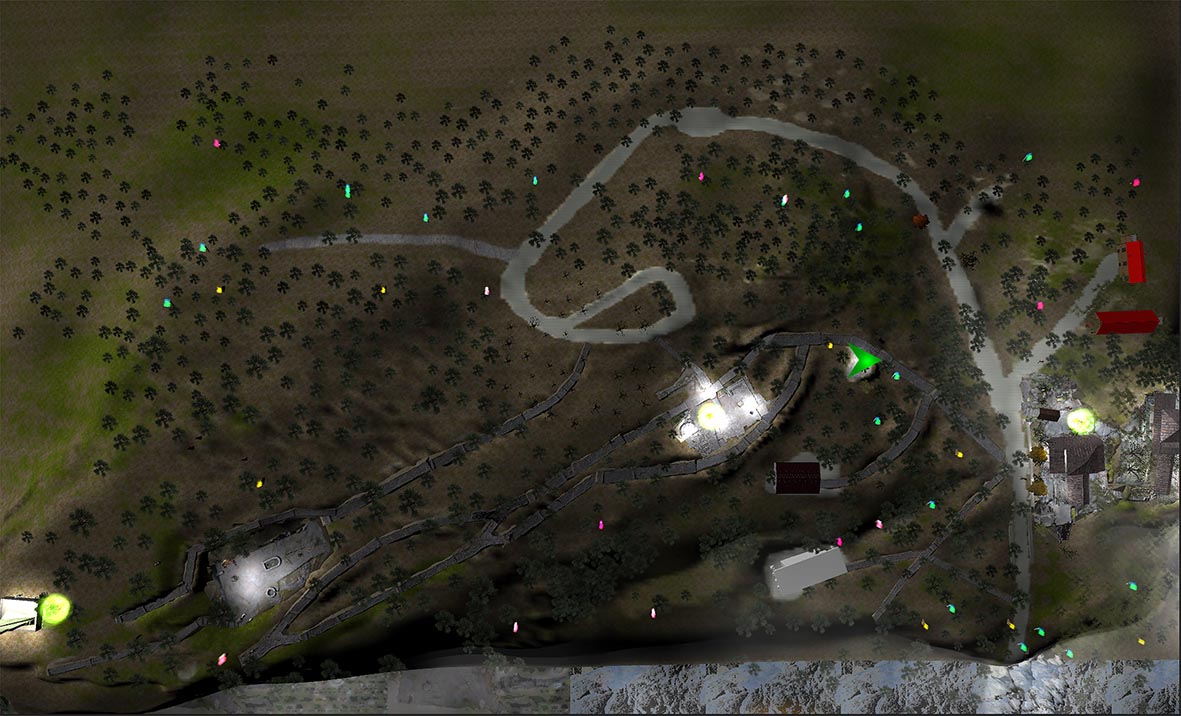 Image captured from the game.
Opposite to Athenian Acropolis hill, in the West-South-West direction, stands the Hill of the Muses, today known as the Philopappou Hill. The hill belongs to a cluster of low hills to the West of the Acropolis that include the Hill of the Nymphs and the Pnyx. On the hill, near the top, there was a shrine dedicated to the Muses, so the name originally given to the hill was “the Museum”. The hill has been inhabited since the beginnings of the Athenian history and even Pericles and Aspasia had their home at its feet. Since the 4th century BC. the hill was fortified by a wall originally constructed to effectively protect Athens from the west; remnants of the wall are still visible. On the top of the hill there are the foundations of the fortification enclosure of 294 BC., which Dimitrios the Besieger built for the installation of a guard. It was there that, in the years of the Roman Empire (around 114-116 AD.) the funerary monument of Gaius Julius Antiochus Epiphanes Philopappos , a descendant of the Seleucids, consul and administrator under the emperor Hadrian, was constructed, thus giving a new name to the hill, a name that still is used.
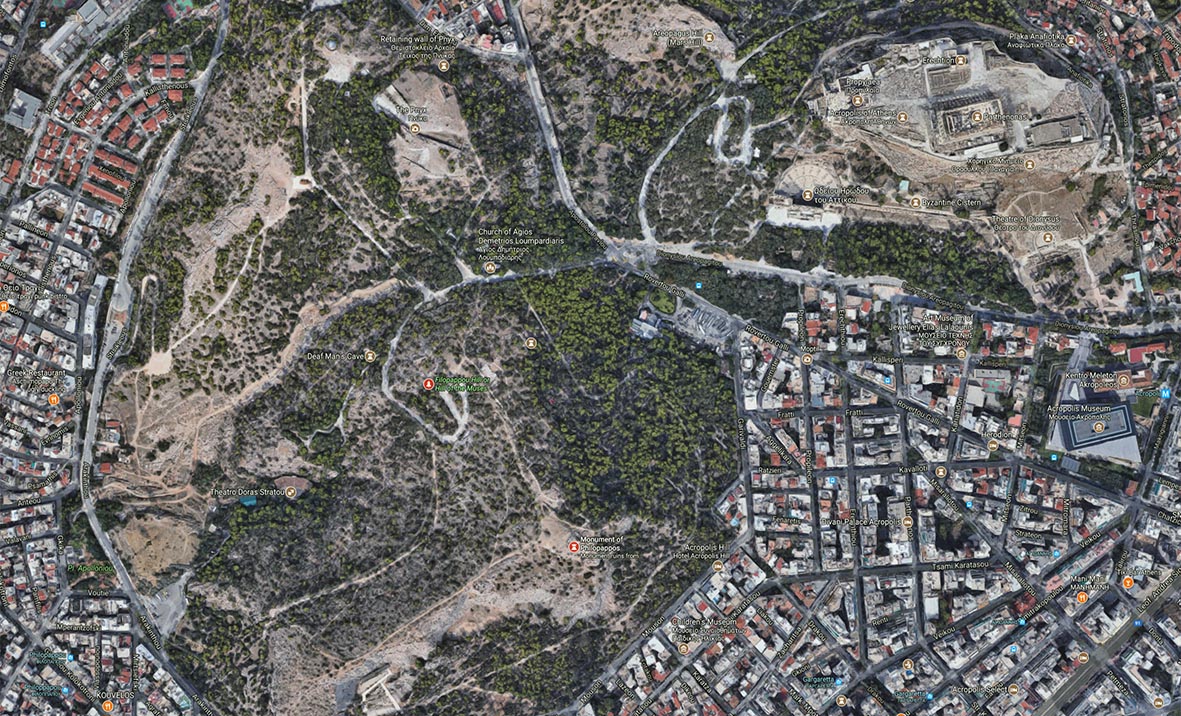 Image captured from Google Maps.
The game scenario in Myth Trek was based on the story of the establishment of the ancient city of Athens by the mythical king Cecrops, who is said to have been born from the Earth and Uranus, and was a man from his waist up and a serpent as regards the rest of his body. Cecrops was the founder of Athens on the Acropolis. He was considered a culture hero namely the one who taught to the Athenians marriage, reading, writing and ceremonial burial. He was considered the originator of the Athenians and his tomb was believed to be located in the northwest part of the Caryatids in the Erechtheion on the Acropolis of Athens, where he was worshiped in his half-man, half-snake form, having his own priest. It was believed that Cecrops must have lived around 1600 BC and that he was married to Aglavros, the daughter of Actaeus (the first king of Attica—the greater region) and the personification of soil fertility and brilliant light; it was also believed that at a later time Cecrops was married to Mitiadousa, sister of Daedalus. Cecrops played a decisive role at the Neptune-Athena competition for the divine protection of the city. Each of the two gods presented their “presents” and claimed the city for her/himself before the jury of all the gods that came down to the hill of Acropolis from Olympus. Cecrops was asked to select: he was in favor of Athena.
"Myth Trek" Environment Development
-
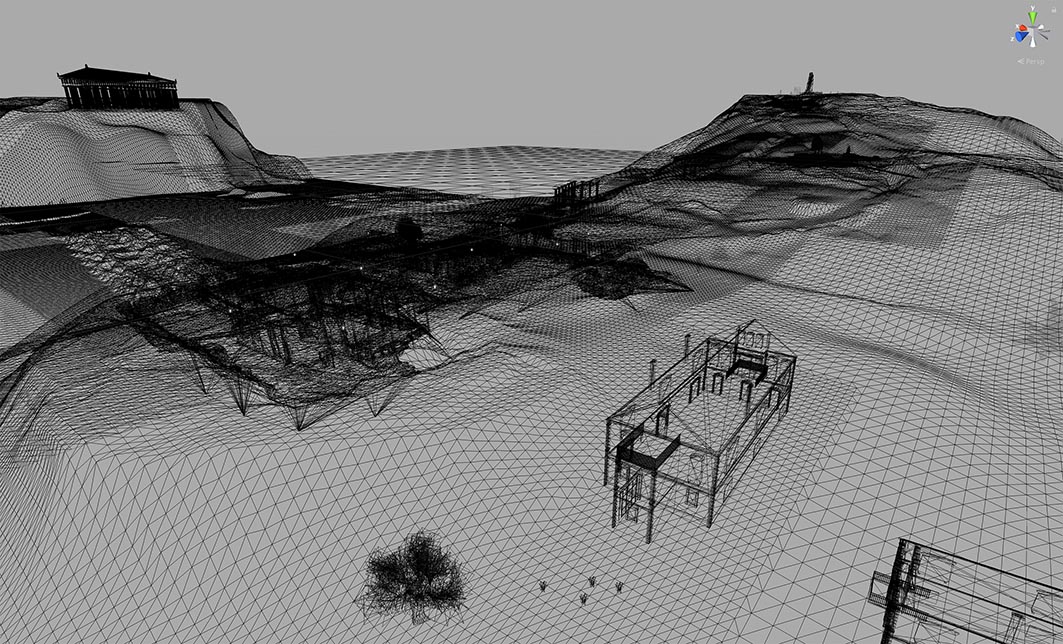
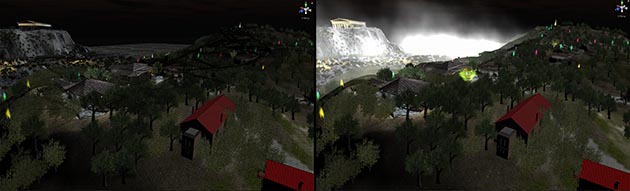
The prototype game was developed for a standalone personal computer desktop environment, in Unity 3D game engine. 3D models created with modelling and digitization where simplified and embedded in the game world. All in-game assets were imported and various effects activated for enhanced realism. Fig.A shows the wireframe representation of the game world, whereas Fig.B presents two screenshots of the game. The picture on the top shows a composite representation with superimposed wireframe but without any after effects while the picture at the bottom shows the final full-featured effects-rich representation.
-
Wireframe representation of the game world.
-
1st superimposed wireframe picture (without any after effects). 2nd final full-featured effects-rich representation.
 Desc.
Desc. Fig. A
 Fig. B
References
Kiourt, C., Koutsoudis, A., and Pavlidis, G. (2016): DynaMus: A fully dynamic 3D virtual museum framework, Journal of Cultural Heritage, Vol. 22, p 984-991, 2016, DOI: [http://dx.doi.org/10.1016/j.culher.2016.06.007]
S. Brown and C. Vaughan,(2010), Play: How it changes the brain, Opens the Imagination, and Invigorates the Soul, J P Tarcher/Penguin Putnam.
S. Nicholson,(2011), “Making the Gameplay Matter: Designing Modern Educational Tabletop Games,” Knowledge QuesT, vol. 40, no. 1, pp. 60-65.
S. Nicholson,(2012), “Strategies for meaningful gamification: Concepts behind transformative play and participatory museums,” in Presented at Meaningful Play 2012, Lansing, Michigan.